Race training · Desert and heat
Badwater 135 training: 135 road miles from below sea level to Whitney Portal
Darren Ware, ULTRALABS coach · updated · 8 minute read
- Distance
- 135 miles / 217 km, all paved
- Start · finish
- Badwater Basin, 85 m below sea level · Whitney Portal, 2,530 m
- Ascent · descent
- 14,600 ft / 4,450 m up · 6,100 ft / 1,860 m down
- Time limit
- 45 hours (cut from 48 in 2026)
- Aid stations
- None. Crew and vehicle mandatory
- Heat
- Furnace Creek July average high 47°C, low 31°C
- Finish rate
- 76 to 94% (2023 to 2026)
- Next edition
- 19 to 21 July 2027, 40th running
- Entry
- Invitation · four 100-mile finishes · $1,595
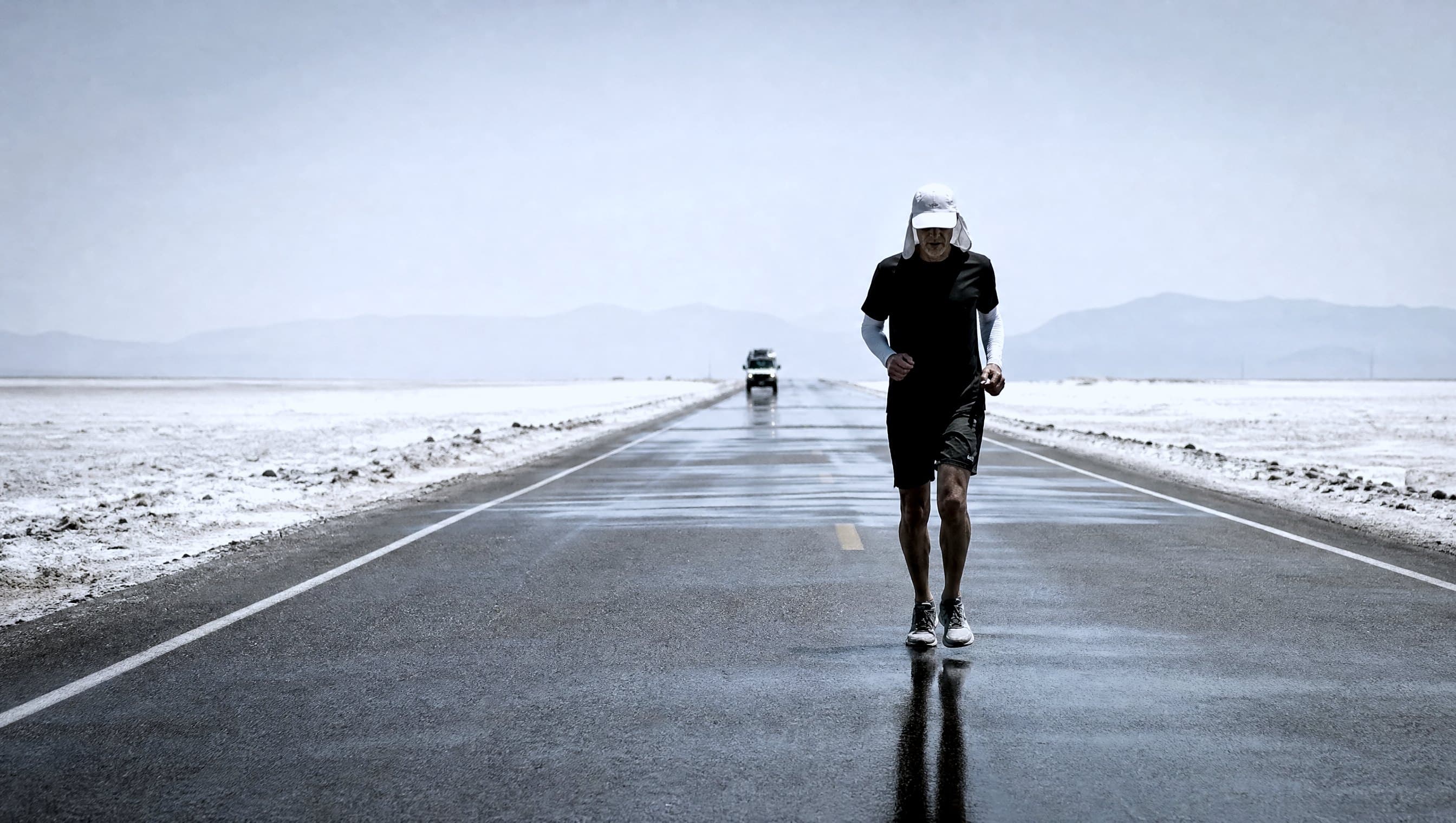
Badwater starts 85 metres below sea level on the salt of Death Valley on a Monday evening in July and finishes 135 miles later at Whitney Portal, 2,530 metres up the side of the highest mountain in the lower 48. Every yard is tarmac, open to traffic. There are no aid stations: your crew, in one vehicle, is your water, your food, your ice and your judgement. Since 2026 the limit is 45 hours. Around nine in ten of the hundred invited runners finish.
Nobody enters Badwater by accident. To be invited you need four hundred-mile finishes, one of them recent. So the field is experienced, and the race still takes one in ten of them. It is heat, roads and sleep, in that order.
The heat is the race
July at Furnace Creek averages 47°C in the afternoon and 31°C at night. The wave starts run from eight to ten in the evening, so you spend the first night at 30-odd degrees and the first full day, through Stovepipe Wells and up Towne Pass, in the worst of it. Cooling vests are not allowed on the move and intravenous fluid means disqualification, so the cooling is ice, water and pace. What decides whether you get through the first day is what you did in the three weeks before it: sauna and hot baths after runs, overdressed running, long runs in the hottest part of whatever summer you have. The heat note sets it out. Acclimation raises plasma volume and sweat rate and lowers heart rate at a given pace in heat; it is the single biggest lever a British runner has, and it decays in two weeks, so it finishes days before the flight, not months.
Three climbs, on roads
Towne Pass begins at mile 42 in the afternoon heat and climbs for 17 miles, then drops 3,000 feet in ten to Panamint Springs. The Portal road starts at mile 123, on legs with 40 hours in them, and climbs 4,750 feet. None of it is technical and all of it is walked by most of the field. Fast, loaded, uphill walking on tarmac is a skill; the walking note covers how I build it. The descent off Towne Pass is where the quads get their one big bill, and it is the eccentric work of the winter that pays it.
Pavement, feet and the crew
A hundred and thirty-five road miles is a repetition problem. The same footstrike, the same tendons, the same two blisters. Back-to-back long road runs teach the feet and calves to tolerate it; shoe choice, a half size up for the swelling, and taping rehearsed in training do the rest. The crew is not support here, it is the race: they mix the bottles, count the sodium, watch you for the signs you cannot see in yourself, and decide when you sleep. Fluid and sodium are planned per hour before you start and adjusted by weight and thirst; both over-drinking and under-drinking put people in the medical tent here, and the hydration note is the starting point. Rehearse the crew in training. A crew that has never handed you a bottle at 30 mph will lose you twenty minutes an hour.
Two nights
A 40-hour Badwater is two nights without sleep. The first is warm and runnable; the second, on the Portal road, can be close to freezing. The night note covers the block I use: overnight rehearsal runs, sleep banking in the fortnight before, and a caffeine plan the crew holds so you do not have to think about it at 3 am.
Where durability shows up
Badwater is decided on Towne Pass and its descent, at hour twelve in the heat. What I read through a build is heart rate at easy pace in the heat block week on week, late-run pace on long road runs against the first hour, and how much the Towne-sized climbs cost once the legs are tired. Road running gives clean watch data, so the durability reads here are the most trustworthy of any race in the library. Then I decide: more heat, more walking, more descent, or rest.
The build
Invitations land in late January for a July race: a base of capped easy road volume and two strength sessions, a spring of long road runs with sustained climbing and one big descent, back-to-back road weekends, a crew rehearsal, then a three-week heat block into the taper. The Portal is 2,530 metres, high enough to notice after 40 hours awake but not high enough to need altitude preparation.
What I watch
- Easy-pace heart rate in the heat block, and the drop that tells me acclimation has taken.
- Sweat rate and sodium on long hot runs, from weight change and the check-in.
- Late-run pace on long road runs against the first hour, the cleanest durability read in the library.
- Uphill walking speed on road at the easy cap, loaded with the bottles you will carry.
- Feet and calves after back-to-back road weekends.
- Sleep in the fortnight before, and how the overnight rehearsal went.
Facts checked September 2026 against badwater.com, the 2026 rules and route documents: 135 miles, Badwater Basin at 280 ft below sea level to Whitney Portal at 8,300 ft, 14,600 ft of ascent and 6,100 ft of descent, the three climbs above, a 45-hour limit from 2026 with wave starts at 20:00 to 22:00, no aid stations and a mandatory crew vehicle, cooling vests and poles banned, IV fluid a disqualification, finish rates of 89%, 76.3%, 94% and 92.6% for 2023 to 2026, and a $1,595 invitation requiring four 100-mile finishes. The 2027 edition is 19 to 21 July. Temperatures are US National Park Service averages for Furnace Creek in July. Evidence level: heat and hydration physiology matches the field notes; the road and crew demands are the race's own.
Invited to Badwater?
Tell me your hundreds, your heat history and who is crewing.