Field notes · Durability
Walking is a race skill. Train it like one
Darren Ware, ULTRALABS coach · · 6 minute read
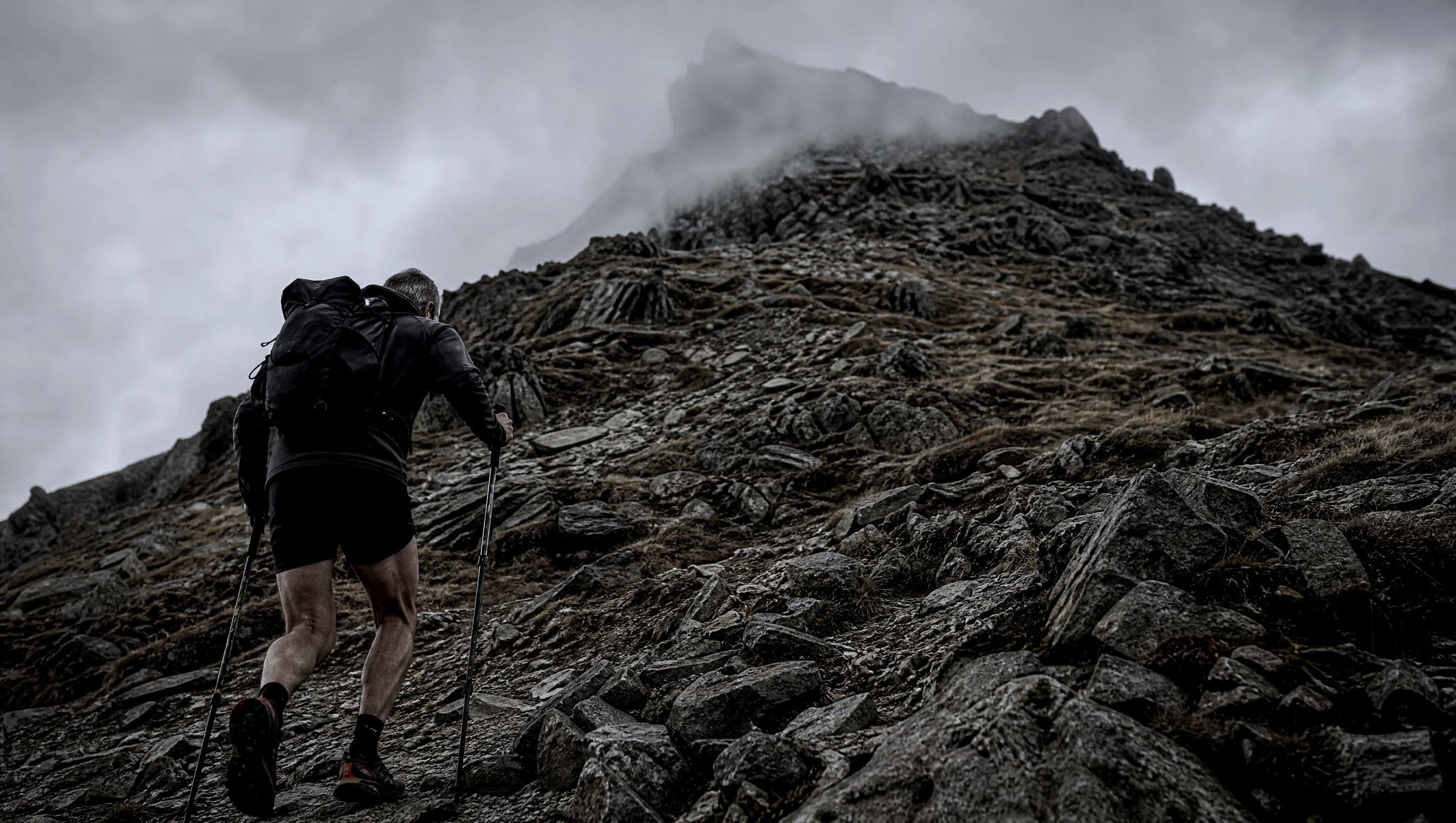
Ask a first-time hundred-mile finisher what surprised them and the honest answer is how much they walked. Ask a Marathon des Sables finisher and it is how much they walked with 9 kg on their back, in sand, at 40°C. Nobody trained for it. They trained to run.
Where walking wins
In treadmill studies of trained mountain runners, walking cost less energy than running at every slope from about 16 degrees upwards, and running was still cheaper at 9 degrees, so the crossover sits somewhere between the two at the climbing speeds most of us hold. On a 30 degree slope walking stayed cheaper up to about 0.7 metres a second. In my experience the crossover arrives earlier once you are tired and loaded, though the studies did not test that. Most mountain ultras spend a large share of their climbing above the line.
Three walks, three skills
- Fast flat walking. Six kilometres an hour on the flat is a skill and it is the MdS long stage. Arm drive, short quick steps, hips forward. Most runners walk at four and a half and think they are moving.
- Loaded uphill hiking. Hands on knees or on poles, a cadence you can hold for an hour, breathing you could talk through. This is where the strength work pays out.
- Walk-run switching. Knowing when to change, and changing without an argument with yourself. Practised on long runs with the decision made by gradient and heart rate, not by mood.
Poles
Poles shift some of the work to the arms and shoulders. In the treadmill studies they lowered perceived effort at most gradients and cut the energy cost by two or three percent on the steepest slopes; on a real mountain path they made a maximal climb faster but no cheaper at ultra pace. So they buy a little economy and a lot of comfort, and they only help if you have trained with them: the arms tire, the rhythm takes weeks to learn, and a runner who unfolds poles for the first time at hour eight has bought a new problem. If your race allows them, they go in from the middle of the build.
How I build it
- Loaded walks start early and short: an hour with the race pack at half weight, on hills, once a week.
- Pack weight rises with the long run, never both in the same week.
- Long runs on mountain terrain include deliberate walk sections at race gradient, timed, so we learn your uphill speed loaded and fresh, then loaded and tired.
- Two strength sessions a week stay in, because loaded hiking is a strength endurance task.
- The last month rehearses race day: real pack, real shoes, real food, the walking speed I expect you to hold.
What I watch
- Uphill speed at the easy heart-rate cap, loaded, over the build.
- Heart rate on the flat walk sections: fast walking should sit below easy running.
- Calf and foot soreness after loaded sessions, the earliest sign the pack is ahead of the tissue.
- Whether the walk-run switches on long runs happen where the gradient says they should.
This is the work behind the Marathon des Sables, Spine Race and Dragon's Back guides. The lifting that makes loaded hiking possible is in the strength note.
Evidence level: the walk-run economy crossover with gradient comes from two treadmill studies of trained mountain runners (Giovanelli and colleagues, 2016 and 2017), fifteen and eleven athletes, so the angle is a laboratory figure and will vary by person. Pole effects on perceived effort and energy cost are from small studies by the same group (2019, 2022); the claim that fatigue moves the crossover earlier is my observation, not theirs. The walking speeds and the pack progression are coaching practice.
Want this applied to your race?
Tell me what you're training for and where things break down.