Race training · Desert and heat
Marathon des Sables training: a week in the Sahara with your food on your back
Darren Ware, founder and coach · updated 2 September 2026 · 8 minute read
- Distance
- ≈250 km · 6 stages (2027)
- Long stage
- 80 to 90 km · 32 h limit
- Pack
- 6.5 to 15 kg, plus water
- Food carried
- 12,000 kcal minimum
- Water
- Rationed, issued en route
- Heat
- Regularly above 40°C
- Finish rate
- ≈94% (2026)
- Next edition
- 2 to 12 April 2027
- Entry
- €3,990 · waitlist
The Marathon des Sables is six timed stages across the Moroccan Sahara in April: around 250 km, with everything you'll eat and sleep in carried on your back. The organisation gives you rationed water and a place in an open Berber tent. Everything else is yours to carry, and yours to manage.
I finished it in 2003. I'm going back in April 2027, at 52. Some of what follows I learned the expensive way the first time. The rest is what twenty years of coaching has changed about how I'd prepare.
The race you actually enter
The MdS is not one long run. It's seven mornings, each started on less sleep, less glycogen and sorer feet than the last. Stages sit around 30 to 40 km, then the long stage, 80 to 90 km with a 32-hour limit, then a marathon. The cut-offs work out near 3.5 km/h, and the finish rate runs above 90% most years. Completing it is a realistic target for a well-prepared runner. Completing it while still moving with intent on day five is a different project, and that's the one worth training for.
- Stages 1 to 3
About 32, 40 and 32 km. Settling in, protecting feet, learning the water rhythm.
- Stage 4
The long stage: 80 to 90 km with up to 32 hours, running into the night and a rest day that isn't restful.
- Stage 5
A marathon, on the week's accumulated damage.
- Stage 6
A half marathon to the line.
Mostly, you will be walking
Under pack, on sand, in heat, the large majority of the field walks most of the route. That's not failure; it's the event. Purposeful loaded walking is the core skill, and it's trainable: carrying economy improves over weeks of practice the same way running economy does. I put loaded walks in the plan as sessions in their own right, and every long run hikes its hills on purpose. If walking still feels like defeat by race week, the training missed something.
The pack
Race rules set 6.5 kg minimum before water; most runners start somewhere over 8. The rule I hold to in training: one variable at a time. New pack weight or peak distance, never both in the same session. Weight goes up in small steps, carriage sessions land every week or two, and by the final rehearsals the full race kit should be boring. The pack also changes your gait and loads your shoulders, hips and calves in ways bare running never did, which is one more argument for the strength work below.
Heat decides more than fitness
The 2021 edition ran over 50°C, a stomach bug went through the bivouac, and roughly half the field didn't finish. That's the honest end of the risk. Your response to heat is trainable: a block of 10 to 14 days of post-run heat exposure, finishing two or three days before you fly, drops your working heart rate and changes your sweat. Then re-test your fluids and sodium in the heat, because the plan you built in a British spring no longer applies. Drink to thirst against your ration, and never treat sodium as permission to overdrink. The full protocol is in the heat training field note.
Fuelling on a deficit
You carry a minimum of 12,000 kcal for the week and you'll burn a multiple of it. Everyone runs a deficit; the race rewards the runner who loses least. That means food you'll still want to eat at 40°C on day four, tested on long hot training runs, plus the discipline of breakfast when you'd rather not and proper eating the moment you reach camp. Gut training is legs training. Rehearse the exact products, and log grams per hour and a gut score on every long session so we're planning from evidence, not optimism.
Feet, sand, camp craft
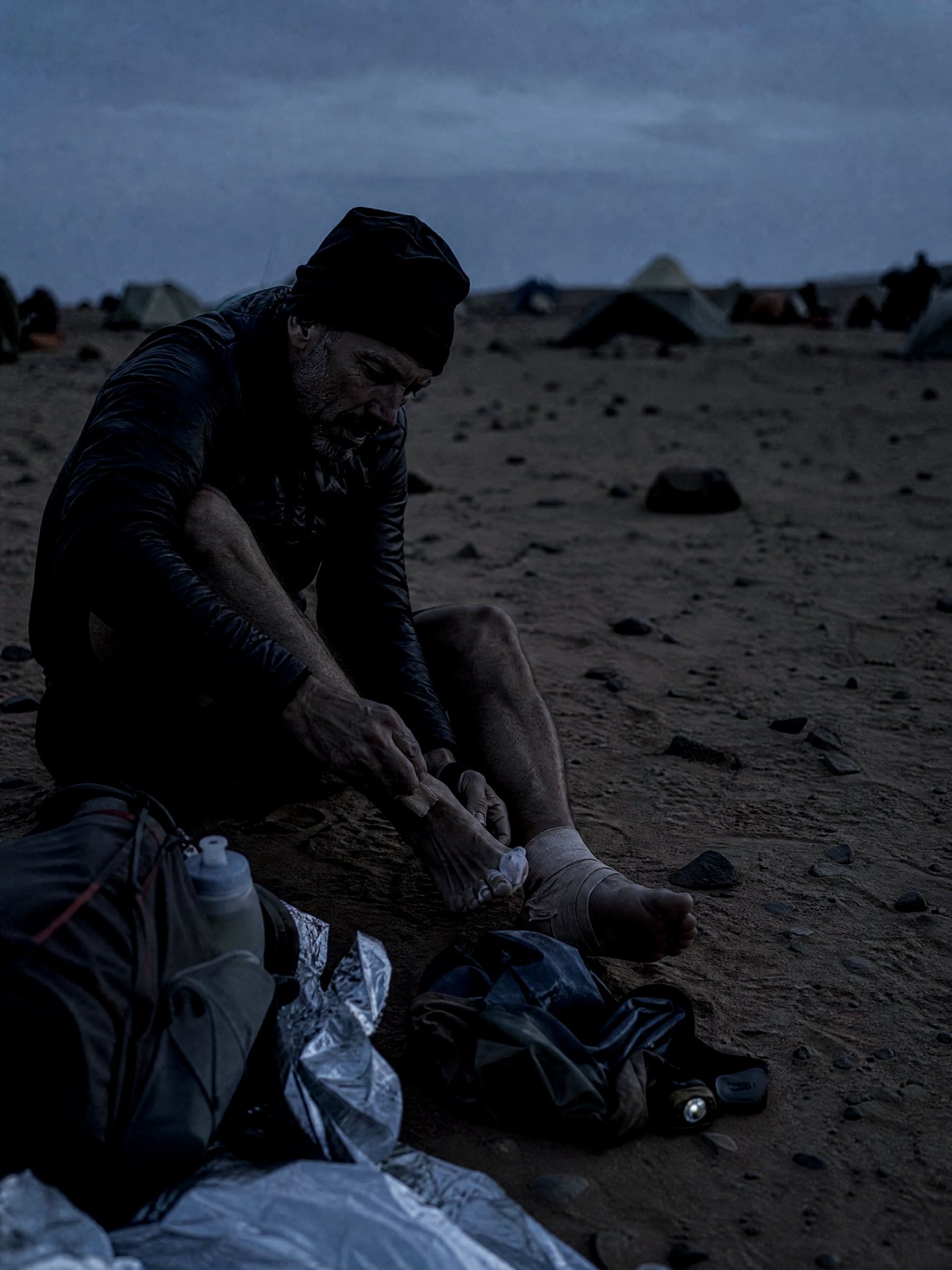
Sand plus heat plus six mornings is a blister factory. Gaiters properly attached, shoes tested at race weight with race socks, taping practised before you need it in anger. Then the part I underestimated in 2003: the race is largely won and lost in camp. Feet dealt with immediately, food in early, kit sorted before dark, sleep taken seriously. The medical team will queue-manage your blisters if you let it get that far; the queue costs you recovery.
Where durability shows up
One observation sits behind the whole Durability programme, and the desert taught me it: your aerobic system can be fine while your legs stop delivering. On a long hot run the data shows it as the same effort costing more heart rate late on, or pace falling at a held effort. Across a multi-day it shows up as day four costing more than day one at the same controlled effort. In an MdS build I read the late-run efficiency of long hot runs, and the day-two cost of back-to-back weekends. The watch can't see your pack weight, so loaded sessions get logged by hand and read as time on feet. The numbers narrow the search; deciding what to change is my job.
The build, roughly
Nine to twelve months is comfortable for a first MdS; a 36-week runway suits a big jump well. A long base of easy aerobic volume under a heart-rate cap with two strength sessions a week. A specific block where loaded walking, back-to-back long days and race-kit rehearsals take over. Heat at the end, then a taper that keeps frequency and drops volume. Sand itself matters less than people fear: soft beach or rough field edges teach the gait, and chasing dunes at the cost of a tendon is a bad trade.
What I watch through an MdS build
- Loaded-walk sessions completing without wrecking the running week around them.
- The heart-rate cost of the same pace late in long hot runs, against the early miles.
- Day two of back-to-back weekends, compared with day one.
- Fuelling on every long session: grams per hour logged, gut score out of ten.
- Feet after long hot or wet sessions, before the race gets to vote.
- Recovery signals once volume peaks: sleep, resting heart rate, and whether the athlete still wants to train.
My own 2027 preparation runs on exactly this: capped easy mileage, two lifting days, loaded walking, gut training and a heat block at the end, with my coaching platform reading the data behind it. Nothing in it is exotic. It's the boring things, done for a year, in the right order.
Facts checked September 2026 against the race's published 2027 information: about 250 km over six competitive stages, pack 6.5 to 15 kg excluding water, 12,000 kcal minimum, entries at €3,990 and currently waitlist only. The route is revealed at the bivouac each edition. Evidence level: heat acclimatisation and load-carriage economy improving with training are well supported; the stage template is the organisation's, and the camp craft is experience, not physiology.
Training for the MdS?
I'm preparing for the same start line. Tell me where you are and what you're carrying.