Race training · Multi-day and extreme duration
Spine Race training: 268 winter miles, most of them in the dark
Darren Ware, founder and coach · updated 2 September 2026 · 8 minute read
- Distance
- 268 mi / 431 km, non-stop
- Ascent
- 10,732 m (official)
- Time limit
- 156 h from 2027 (was 168)
- Daylight
- About 8 hours a day
- Checkpoints
- 5 · stays capped at 6 h
- Drop bag
- One, 20 kg maximum
- Finish rate
- ≈57% (2026)
- Next edition
- 10 to 16 Jan 2027
- Entry
- £1,345 · vetted · 150 places
The Montane Winter Spine is the full Pennine Way, Edale to Kirk Yetholm, in January, non-stop. Five checkpoints with hot food and a sleep area; between them you're on your own, in whatever weather the Pennines arrange, with your safety kit on your back. Support crews are banned. From 2027 the limit is 156 hours, tightened from the old seven days, and checkpoint stays are capped at six hours.
Start with the arithmetic. 431 km in 156 hours is under 3 km/h, averaged across everything: moving, eating, sleeping, faffing with frozen zips. Almost nobody fails the Spine because they can't move at 3 km/h. Around 4 in 10 starters still fail. They fail because moving at all stops being possible: feet, cold, sleep debt, and small kit mistakes made at 2 am with cold hands.
Sixteen hours of dark
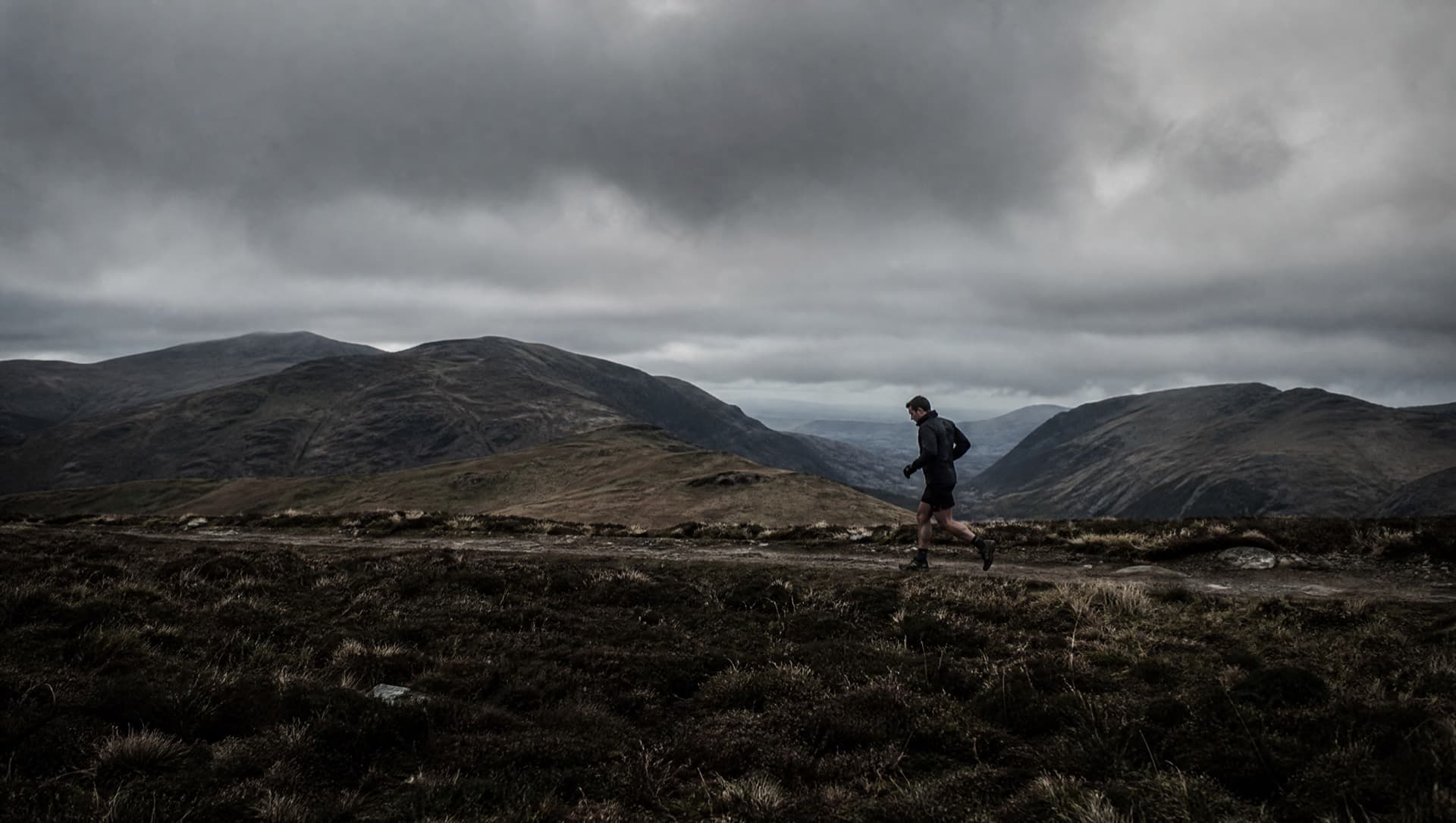
Navigation in cloud, on featureless moor, at night, while tired, is a skill with no substitute. So is the flatter discipline of eating and drinking when nothing about the situation invites it. Training has to include real nights: not a headtorch 10k, but long winter efforts that start in the evening and keep going, on the kind of ground the race uses, ideally on the route itself. Recce weekends on the Pennine Way do double duty: navigation practice and the most specific training the race allows.
Mostly walking, always loaded
Your race pace on the Spine is a strong, purposeful walk you can hold for days, wearing a winter pack. That's the thing to train, deliberately: loaded hiking on rough ground, uphill, in bad weather, at a pace you could repeat tomorrow. Running fitness still matters, because the runnable sections are where the time limit is won, and because the aerobic base underneath everything is built by ordinary capped easy running long before the winter-specific work starts.
Feet in winter water
Your feet will be wet from the first hours and stay wet for days. Softened, macerated skin ends more Spine races than any tendon does. Skin can't be toughened in the final month, but the routine can be rehearsed: sock and shoe strategy tested on wet recces, taping practised until it's quick, and a fixed feet-first ritual at every checkpoint. Boring, repeatable, non-negotiable.
Sleep is a race skill
You can't train yourself out of needing sleep, and trying to in training just wrecks the block. What you can train is the decision-making around it. A pre-decided sleep plan: where, how long, and what would make you take more. A rehearsal weekend or two: an overnight effort, a few hours down, then moving again on tired legs, so the feeling isn't new. The six-hour checkpoint cap from 2027 punishes drift; the plan has to be deliberate before the race starts, because nobody plans well at hour 90.
Cold discipline
The kit list is mandated for good reason: a sleeping bag rated to 0°C or lower, bivvy bag, stove, the layers. The trainable part is using it: layering while wet without stopping for ten minutes, eating enough when cold suppresses appetite while raising the need, getting the stove out with useless fingers. Practise the kit in conditions you'd otherwise avoid. If January is the first time you've cooked in sleet, that's a training error, not bad luck.
Where durability shows up
The Spine is durability at its longest wavelength: not pace fade over hours, but whether output survives days. I'll be honest about what the data can and can't tell you here. Heart rate under winter layers, in cold, while hiking is a blunter signal than summer running, and the late-run efficiency readings I use elsewhere want steady running to read from. So through a Spine build I lean on the readings where they're valid, in the base months, and then on plainer evidence: whether the long efforts were completed as planned, what the day after cost, how the feet came through, what the athlete reports. The data informs it. It doesn't replace judgement, and on this race judgement is most of the game.
The build
The entry requirement, an 80-mile finish or equivalent, is also the syllabus: the race assumes you already own a big engine and long-race craft. A year out, it's ordinary ultra training: capped easy volume, two strength sessions, patient long-run progression. From autumn the work turns specific: back-to-back loaded moorland days, night sections, wet recces, a long overnight rehearsal with the sleep plan, kit used in anger. Then a generous taper, because this race takes more out of a body in training than the sessions look like they should.
What I watch
- Whether night sessions actually happen, and how the navigation held up tired.
- Loaded hiking pace on rough ground, fresh versus at the end of a long day.
- Day two of back-to-back weekends against day one.
- Feet after every long wet session, before January gets to vote.
- Eating in the cold, logged: appetite falls exactly when the need rises.
- Recovery signals through the darkest training months, motivation included. That's data too.
Facts checked September 2026 against the race's published 2027 information: 268 miles, 10,732 m of ascent, a 156-hour limit and six-hour checkpoint stays from January 2027, one 20 kg drop bag, entry £1,345 with experience vetting. The 2026 edition finished around 57%; the record stands at 72:55 (Jack Scott, 2024). Evidence level: the physiology here, walking economy, fuelling, recovery, matches the field notes; the sleep, cold and navigation craft is race experience and the race organisation's own guidance, not laboratory science.
Thinking about the Spine?
Tell me your longest winter effort so far, and where you are with nights and navigation.