Race training · Mountain and technical
UTMB training: the race is won and lost on the descents
Darren Ware, founder and coach · updated 2 September 2026 · 8 minute read
- Distance
- ≈174 km
- Ascent
- ≈9,700 m, matched by descent
- Time limit
- ≈46 h
- Nights out
- Two for almost everyone
- High point
- Grand Col Ferret, ≈2,530 m
- Drop bags
- Courmayeur, Champex-Lac
- Finish rate
- ≈70% (2026)
- Entry
- Index + Running Stones lottery
UTMB is a loop of the Mont-Blanc massif from Chamonix, through Italy and Switzerland and back: about 174 km with roughly 9,700 m of ascent. The number people quote is the climbing. The number that ends their race is the descending, which is exactly as much. Ten major climbs, ten long descents, most of it above the treeline, across two nights.
Climbs cost fitness, descents cost muscle
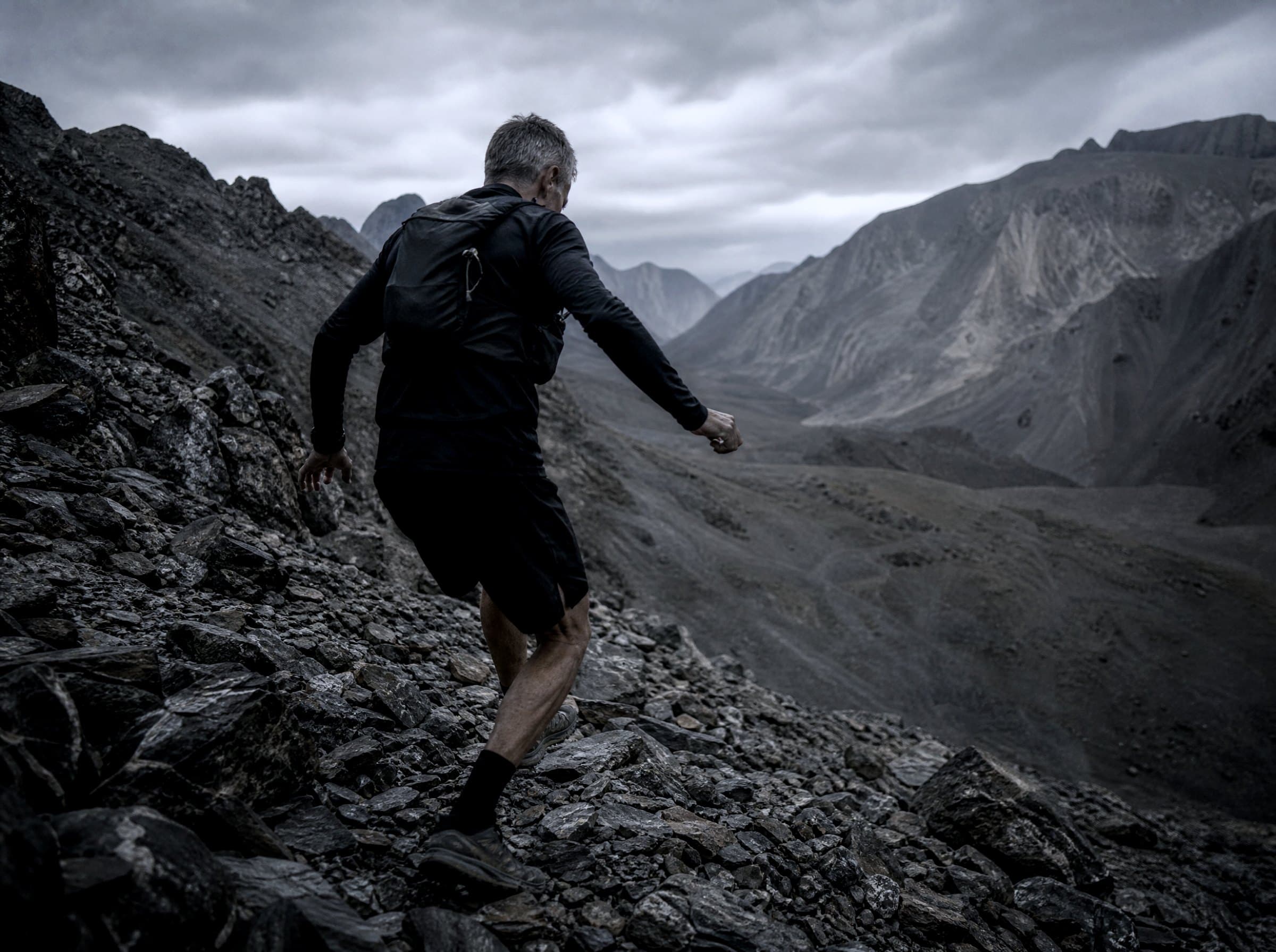
Going up is a cardiovascular and strength problem, and it's the one most people train, because it's obvious and it hurts in a familiar way. Going down is a tissue problem. On every descending step your quads work as brakes, producing force while lengthening. That eccentric load is what tears muscle, and the bill arrives hours later. Runners who feel strong at Courmayeur come apart on the drops into Switzerland, not because the engine failed but because the legs stopped absorbing landings.
Building legs that still descend at hour 30
Descent tolerance has one reliable friend: the repeated-bout effect. One hard downhill session protects you from the next; the soreness after the second drops sharply. So the descents get trained early and gradually, learned fresh before they're practised tired, and backed by heavy strength work in the gym, which builds the same tissue the drops attack. Later in a build, descents go on tired legs on purpose, because that's the race. Chasing a single monster downhill three weeks out, on legs that can't yet take it, buys an injury instead of an adaptation. The full progression is in the descent training field note.
Climbing, poles and the long grind
Most of UTMB's uphill is power-hiked, not run, so strong efficient hiking is a trained skill, not a fallback. Poles are allowed and worth it if you'll actually practise with them: they take a measurable share of load off the legs on the climbs and steady you on technical ground, but only if the technique is grooved and your upper back can hold them up at hour 30. The engine underneath all of it is still ordinary capped easy aerobic volume, built long before the mountain-specific block. Vertical and technical terrain are the specificity; the base is the base.
Fuelling and the two nights
You'll be moving for the best part of two days and through two nights, and appetite fades exactly when the climbing demands most. That makes fuelling a rehearsed skill: a target of grams per hour you can absorb on steep ground, tested on long mountain days, with food you'll still tolerate cold and tired in the dark. Add the temperature swing, valleys near 30°C, cols below freezing, and pacing that respects both, and the race stops being a fitness test and becomes a management test.
Where durability shows up
UTMB is the clearest case of the thing Durability is built around: your aerobic system can be intact while your legs stop delivering. On a long mountain run the signal I read is downhill pace late in the run against the same descents fresh, how much speed disappears after a big climb, and whether foot control and braking survive once the legs are tired. Be clear on what the watch does here: grade-adjusted pace and heart rate on steep technical ground are approximate, so I read the durability numbers on the runnable, comparable sections and treat the technical descents as observed evidence, logged, not measured to two decimal places. The data points me at the weak link. The decision to load descents, add gym work or hold volume is mine.
The build
A base of capped easy volume and two strength sessions, then a mountain-specific block that shifts the centre of gravity onto vertical: back-to-back hill days, long descents introduced early and progressed, poles rehearsed, night sections, fuelling drilled on steep ground. If you live somewhere flat, treadmills, repeats and stair or hill reps carry the climbing, but descending has to be found: real downhills, taken often, are the one thing you can't fake. A generous taper, because mountain volume takes more out of the legs than it looks like on paper.
What I watch
- Downhill pace late in long runs, against the same descents run fresh.
- How much speed the legs lose after a sustained climb.
- Whether braking control and foot placement hold once tired, or go ragged.
- Climbing efficiency with and without poles, and whether the upper body lasts.
- Fuelling on steep ground: grams per hour logged, gut score out of ten.
- Recovery after the biggest hill weekends, because that's where masters legs get caught.
Facts checked September 2026 against the race's 2026 information: about 174 km and 9,700 m of ascent, roughly a 46-hour limit, drop bags at Courmayeur and Champex-Lac, no pacers, entry via UTMB Index plus Running Stones into a lottery. The 2025 and 2026 courses ran slightly short after a technical col was bypassed; 2027 dates were not yet published. Evidence level: eccentric damage, the repeated-bout effect and pole load reduction are well supported; the training progression is coaching practice built on that evidence.
Training for UTMB or the World Series?
Tell me your climbing volume and how your quads hold up on long descents.