Race training · Mountain and technical
Dragon's Back Race training: six mountain days down the spine of Wales
Darren Ware, founder and coach · updated 2 September 2026 · 7 minute read
- Distance
- 380 km over 6 days
- Ascent
- 16,400 m (official)
- Route
- Conwy Castle to Cardiff Castle
- Day 1
- ≈50 km, 4,100 m, Snowdonia
- Navigation
- Self-navigated, unmarked
- Camps
- Provided, with catering
- Finish rate
- ≈32% full course (2025)
- Organiser
- Ultra X (from 2026)
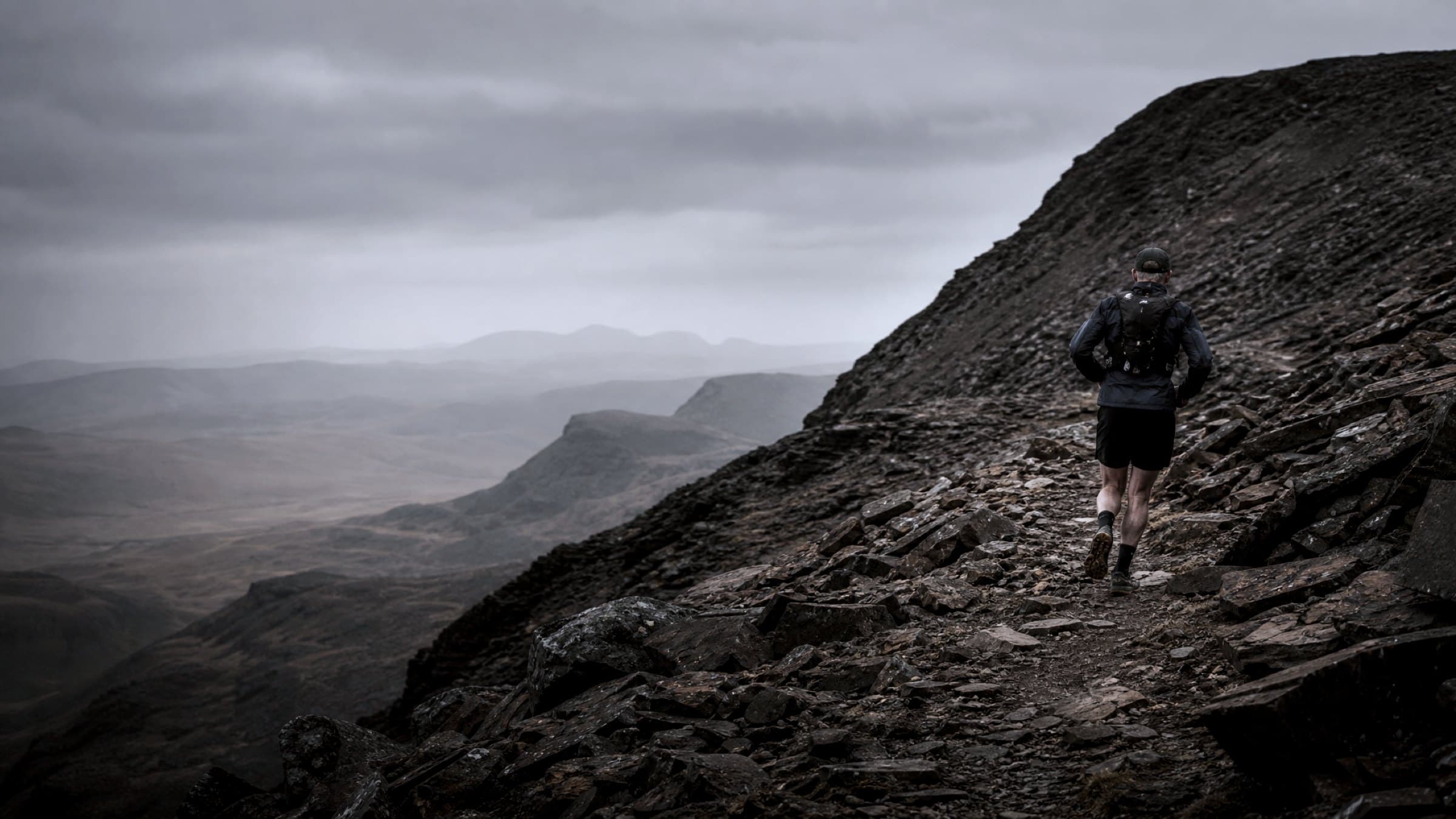
The Dragon's Back runs the mountainous spine of Wales, Conwy Castle to Cardiff Castle, over six days: 380 km with 16,400 m of ascent, self-navigated across trackless, technical ground. Camps and catering are provided; the navigation and the recovery are yours. The organiser changed hands in 2026, and from that year the race uses a single mandatory route rather than the old choose-your-line format.
Six days that add up
Day one is the hardest single day in British stage racing: around 50 km with 4,100 m of ascent over Snowdonia, including scrambles where poles get stowed. But the race isn't day one. It's whether day one's damage has faded by the time day five, 75 km over the Bannau Brycheiniog, arrives. Finish rates for the full course run around a third, and the runners who don't finish are rarely unfit. They're carrying an injury or an accumulation that day two or three set in motion.
- Day 1 · Snowdonia
≈50 km, 4,100 m. Carneddau, Glyderau, Crib Goch, Yr Wyddfa. The scrambles are here.
- Days 2 to 3
≈60 and 66 km. Rhinogydd, the most broken terrain of the race, then the Cambrians.
- Day 4 · Elan Valley
≈67 km of tussock moor. Less ascent, its own kind of grind.
- Day 5 · Brecon Beacons
≈75 km, 3,200 m, to Pen y Fan. Officially the likely crux, on five days of fatigue.
- Day 6 · to Cardiff
≈65 km, easier paths, the finish.
Descending is the tissue that decides it
Consecutive mountain days are an eccentric-damage problem before they're anything else. Every descent bills the quads, the bill compounds overnight, and by day three a runner who never trained downhills is braking with legs that can't absorb the landings. So descent tolerance built early, heavy strength work through the base, and the repeated-bout effect banked in training rather than discovered on the mountain. This is the same tissue argument as UTMB, sustained across a week instead of a night.
Navigation is fitness you can't fake late
The route is unmarked and the ground is trackless. Navigation while fresh is a skill; navigation on day four, in cloud, tired, with a map and a compass, is a different one, and it's the one the race tests. It has to be trained on real mountains in bad visibility, not rehearsed from an armchair. A wrong line on the Rhinogydd doesn't just cost time, it costs the extra climbing and the extra damage that ends the next day.
Recovery between stages is a trained skill
The race is decided in camp as much as on the hill: food in early, feet dealt with, legs elevated, sleep taken. In training that means back-to-back mountain weekends where the point of day two is learning to move well on yesterday's damage, and learning what actually helps you recover overnight. Eat, sleep, feet: unglamorous, and the difference between finishing and a DNF at Elan Valley.
Where durability shows up
The Dragon's Back is durability measured in days, not hours. The reading I trust most through a build is the cost of day two against day one on back-to-back weekends: same controlled effort, how much more does it take. On individual long mountain runs I watch late-run descending pace and whether control survives fatigue. On steep technical ground the watch numbers are approximate, so those are read as logged evidence rather than precise metrics. The data shows me whether the legs are learning to absorb consecutive days; I decide whether to add descent work, hold volume, or build more recovery into the block.
The build
An aerobic base under a cap with two strength sessions, then a specific block dominated by back-to-back mountain days, technical descents, real navigation in poor conditions, and a rehearsal of the camp routine. Fuelling and feet drilled on long wet days. A patient taper, because six mountain days need legs that arrive fresh, not fitness that arrives tired.
What I watch
- Day two against day one on back-to-back mountain weekends, at matched effort.
- Late-run descending pace and whether braking control holds.
- Navigation accuracy when tired and visibility is poor.
- Feet and recovery overnight after long wet technical days.
- Fuelling across consecutive days, logged, not remembered.
- The recovery signals that tell me the accumulation is winning before an injury does.
Facts checked September 2026 against the race's published information: 380 km, 16,400 m of ascent over six days, Conwy to Cardiff, self-navigated, a single mandatory route from 2026, and full-course finish rates around a third. The race was acquired by Ultra X in April 2026; 2027 dates were not yet announced. Evidence level: eccentric damage and consecutive-day fatigue are well supported; the navigation and camp-craft demands are the race's, and the recovery practice is coaching experience.
Eyeing the Dragon's Back?
Tell me your mountain days and how you recover from back-to-back efforts.