Race training · Mountain and technical
Tor des Géants training: 330 kilometres and 25 passes with the clock never stopping
Darren Ware, ULTRALABS coach · updated · 8 minute read
- Distance
- 330 km advertised · about 350 km measured
- Ascent
- About 24,000 to 25,000 m
- Passes above 2,000 m
- 25 · high point about 3,300 m
- Time limit
- 150 hours, continuous
- Life bases
- Six, with meals, showers and rest; time barriers at each
- Sleep
- Only at organiser-controlled points; 2 h cap at refreshment points
- Finish rate
- About 60% historically
- Next edition
- 13 to 19 September 2026, Courmayeur
- Entry
- Lottery, 1,100 bibs · €990 · no time standard
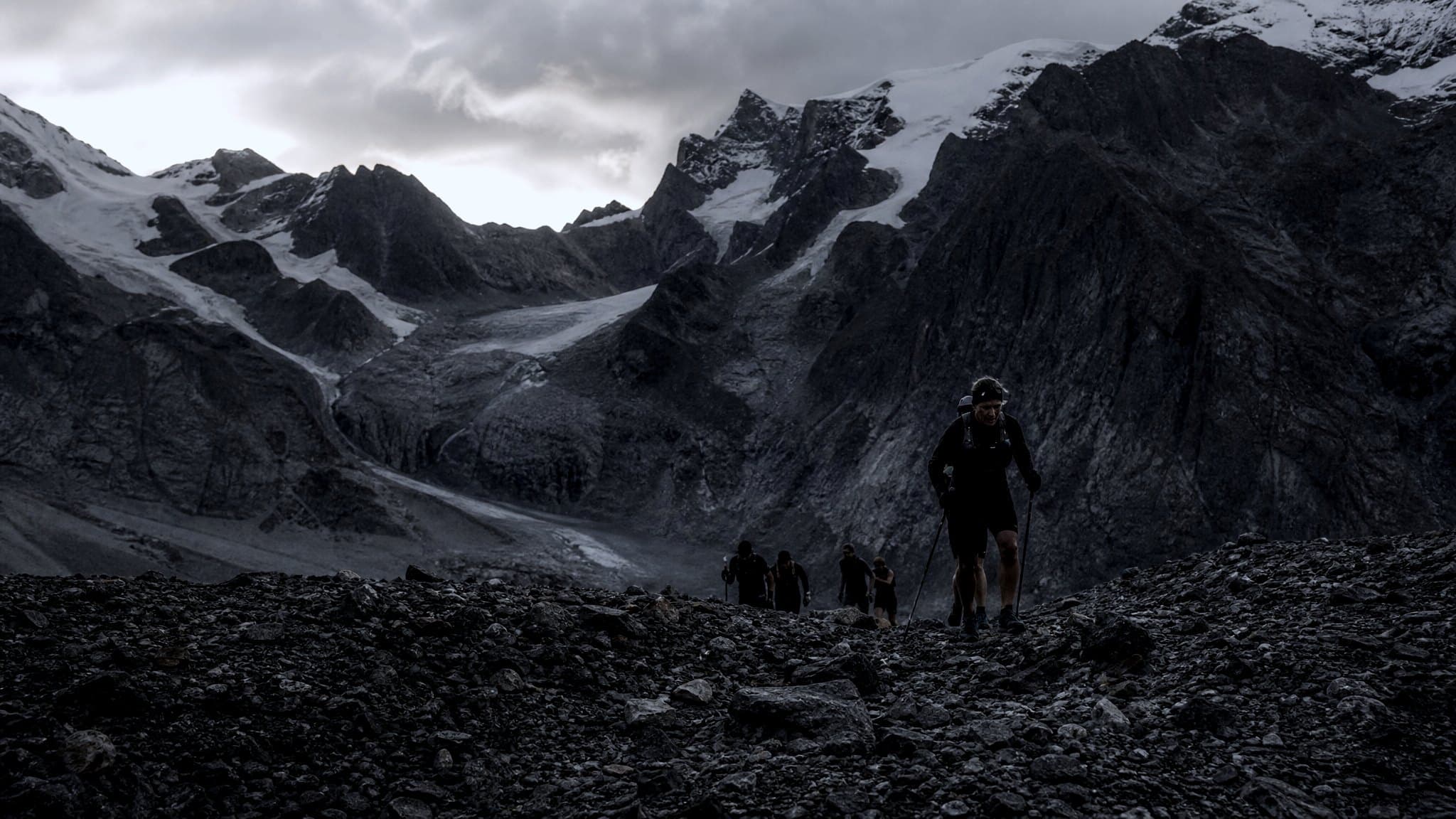
The Tor des Géants is a loop of the Aosta Valley on the two Alte Vie, starting and finishing in Courmayeur: 330 kilometres advertised, closer to 350 measured, with around 25,000 metres of climbing over 25 passes above 2,000 metres. The clock runs for 150 hours and never stops. You sleep where the organisers let you, in six life bases and at refreshment points for no more than two hours at a time. Sleeping anywhere else is disqualification. About six in ten finish, and in 2015, after ice on the high passes, six people did.
It is the longest race in the library and the one that least resembles running. The Tor is walking, eating, sleeping and dressing, done well, for six days.
Twenty-five thousand metres of walking
Nobody runs the climbs on the Tor and most of the descents are walked too. Uphill economy with a loaded pack and poles is the whole engine: 25 passes of six hundred to fifteen hundred metres each, on grades of 25 to 30 per cent, day after day. The walking note is the training, and it starts early in a Tor build, because the adaptation is in the calves, the hips and the habit as much as the heart. Poles are used by almost everybody who finishes.
Sleep is a decision, not a weakness
A mid-pack Tor is five nights. The runners who finish plan their sleep the way they plan their food: a life base every 50 to 70 kilometres with a bed, a shower and a hot meal, ninety minutes to three hours down, then out before the time barrier closes behind them. The runners who do not finish try to skip the first night, hallucinate on the second and lose a day on the third. The night note covers the block I use and the sleep banking beforehand; the Tor adds a rehearsal of sleeping badly in a strange bed and getting up anyway.
- Courmayeur, Sunday
Two waves, 10:00 and 12:00. Col Chécrouit and the first high ground before dark.
- Valgrisenche
First life base. Most runners push through to it on the first night.
- Cogne
Second base, after the Loson pass, the highest point on the course at about 3,300 m.
- Donnas
Third base and the low point at about 300 m. Hot in the valley, then the longest climb on the course.
- Gressoney, Valtournenche, Ollomont
Three bases and the second half of the passes, on the fourth and fifth nights.
- Courmayeur, Saturday 18:00
150 hours.
Winter kit in September
The regulations say plainly that kit adequate for ordinary trail running may not be adequate here. Passes above 3,000 metres in mid-September bring snow, ice and wind with sudden violent changes, and the mandatory list runs from a hooded thermal jacket for below zero to crampons with 8 mm spikes in the drop bag. Kit discipline is trained: layers on before the col, not at it, gloves that work wet, torch changes rehearsed at 3 am. A handheld GPS with the track is compulsory and a watch alone is not accepted; the course is marked and the marmots are not the problem here, but the weather that hides the markers is.
Descents, feet, food
Twenty-five thousand metres down on scree and wet rock is the quad bill of three mountain hundreds, and the descents note is where the winter strength work earns its place. Feet are managed at every base: dry socks, tape, a foot-care routine practised at home until it is automatic. Food is refuge food, pasta and soup and bread, every seven to ten kilometres, and the gut is trained on real meals rather than gels.
Where durability shows up
Watch data on a six-day race is a diary rather than a measurement, so the durability reads in a Tor build come from the long mountain days beforehand: uphill walking speed at the easy cap, loaded, over the months, and how the legs descend on the second day of a back-to-back weekend. Recovery markers after the biggest weekends tell me whether the athlete is absorbing the work, and the watch note is how I read them. Then I decide what the next block holds.
The build
The lottery is in February for September. A winter of capped easy volume and two strength sessions; a spring and summer of long loaded mountain days with poles, back-to-back and then three-day weekends, descents progressed on rock; an overnight rehearsal with a refuge sleep in it; a foot-care routine and a kit system tested in bad weather; then a three-week taper with the sleep banked. Altitude at 3,000 metres is felt but not the limiter; the cold is.
What I watch
- Uphill walking speed at the easy cap, loaded with the full mandatory kit, over the build.
- Descending on the second and third day of multi-day training weekends.
- Sleep and recovery markers after the biggest weekends, where masters legs get caught.
- Kit and food discipline in bad weather, from the check-in.
- Feet after long wet days, and whether the routine is being done.
Facts checked September 2026 against torxtrail.com and the 2026 regulations: 330 km advertised and about 350 km with around 25,000 m of climbing as evaluated, sections above 3,000 m, a 150-hour limit, six life bases with time barriers, two-hour rest caps at refreshment points, sleeping outside controlled areas forbidden, the mandatory kit list including crampons and a handheld GPS, 1,100 bibs by lottery at €990, and the 13 to 19 September 2026 dates. The 25 passes, the high and low points and the historical finish rate of about 60% are from published secondary descriptions rather than the organiser. Evidence level: the walking, descending and sleep physiology matches the field notes; the alpine demands are the race's own.
Drawn for the Tor?
Tell me your longest mountain days and how you sleep in a refuge.